
"Why am I gaining weight when nothing has changed?"
You haven't changed what you eat or how much you move. Your body has changed how it processes everything you do. These are different problems.
One of the most common and most distressing experiences in perimenopause is watching body composition shift despite doing all the 'right' things. For many women, this isn't a matter of eating more or moving less, it reflects a genuine biological shift in how the body stores fat, uses energy, and responds to the same inputs it's always had.
Where the weight goes
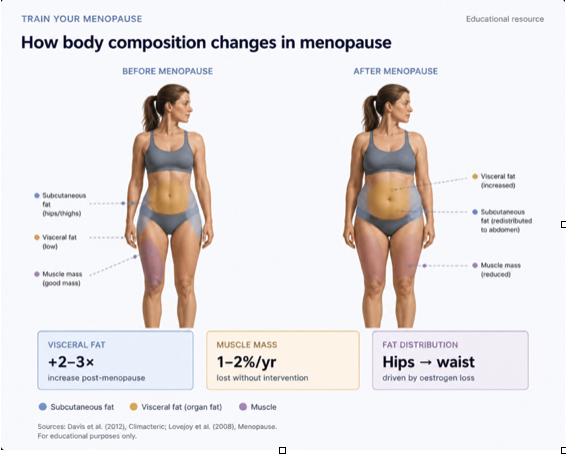
Before menopause, oestrogen promotes fat storage in the hips, thighs, and buttocks, the gynoid distribution pattern. It also has a protective effect on insulin sensitivity and metabolic function. As oestrogen falls in the menopause transition, fat redistribution towards the abdomen begins. Research shows that visceral fat (the metabolically active fat stored around the organs) increases from around 5–8% of total body fat in premenopausal women to 15–20% postmenopause, on average.
This isn't about aesthetics; visceral fat is associated with higher cardiometabolic risk, including elevated LDL cholesterol, raised blood pressure, insulin resistance, and increased cardiovascular disease risk. That's why body composition in menopause matters clinically, not just cosmetically.
The metabolic shift
Oestrogen plays a direct role in how your body uses fat for fuel. When oestradiol levels fall, the body becomes less efficient at burning fat as energy and more inclined to store it. This means that for the same calorie intake, the body is more likely to store fat and less able to use it as fuel. Your metabolism hasn't broken. It has changed.
Insulin sensitivity also decreases. This matters because insulin resistance shifts the metabolic dial further towards fat storage, particularly centrally. It also affects the appetite signalling hormones, leptin and ghrelin, which means hunger and fullness cues become less reliable.
What helps
Resistance training is the most evidence-backed intervention for improving body composition in menopause. Building and maintaining lean muscle mass raises resting metabolic rate, improves insulin sensitivity, and directly counteracts the fat-accumulation signals coming from oestrogen withdrawal. Cardiovascular exercise matters too, but the evidence specifically supports resistance work for body composition in this phase.
Protein intake becomes particularly important (more on this in its own post). Eating at a large calorie deficit isn't the answer; it tends to accelerate muscle loss and can worsen cortisol-driven fat storage. The goal is working with the changed metabolic environment, not fighting it with restriction.
WORTH KNOWING
Menopause Hormone Therapy (MHT) has not been shown to cause weight gain, a persistent myth. A Cochrane review found no adverse effect of oestrogen-only or combined therapy on body weight or BMI. Some trials have found that MHT helps maintain lean body mass and reduces the shift towards android fat distribution. It's another piece of the picture, not a magic fix.
Key references: Davis et al. (2012), Understanding weight gain at menopause, Climacteric; Lovejoy et al. (2008), Menopause; Santoro et al. (2022), PMC; Lizcano & Guzmán (2014), ISRN Obesity.
These resources are for educational purposes only and do not constitute medical advice. Please consult your GP, physiotherapist, or menopause specialist before making changes to your exercise, nutrition, or medication.