
Are you eating enough protein?
Most women in menopause are not.
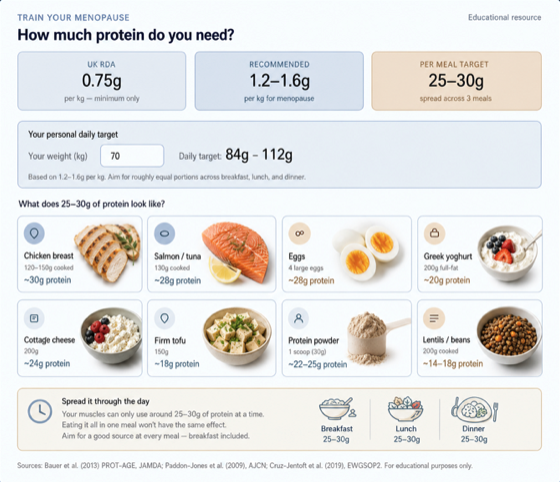
The UK government's recommended daily allowance (RDA) for protein is 0.75g per kilogram of body weight. For a 70kg woman, that's about 52g per day. The problem is that this figure was established using nitrogen balance studies conducted mainly in young adults, and it represents a minimum to prevent deficiency, not an amount to support muscle maintenance, bone health, or metabolic function in a postmenopausal woman who is trying to stay strong.
Why protein needs increase in menopause
Muscle protein synthesis, the process of building and repairing muscle tissue, becomes less efficient with age. Older muscle is less responsive to the anabolic signal from dietary protein. This phenomenon, called anabolic resistance, means you need more protein to produce the same muscle-building effect than you would have at 30. Add in the withdrawal of oestrogen (which has its own anabolic role in muscle), and the case for increasing protein intake becomes clear.
The PROT-AGE expert group, and more recent consensus statements on sarcopenia prevention, recommend protein intakes of 1.2–1.6g per kilogram of body weight per day for older and postmenopausal women. For a 70kg woman, that's 84–112g daily. Research combining this level of protein intake with progressive resistance exercise consistently shows better outcomes for lean mass preservation than either intervention alone.
Spreading it through the day matters
How you distribute protein across the day is as important as total daily intake. Muscle protein synthesis is maximised when each meal contains a meaningful dose, research suggests around 25–30g of high-quality protein per meal as the practical target. Eating 10g at breakfast, 15g at lunch, and cramming the rest into dinner doesn't produce the same stimulus. Three meals each containing a good protein source is the practical starting point.
WHAT 25–30G OF PROTEIN LOOKS LIKE
120–150g cooked chicken breast or salmon • 4 large eggs • 200g Greek yoghurt (full-fat) • 200g cottage cheese • 150g firm tofu • 30g whey or plant protein powder mixed into oats or a smoothie. Combining sources across a meal is perfectly valid.
Plant versus animal protein
Animal proteins, meat, fish, eggs, dairy, are 'complete,' meaning they contain all essential amino acids in readily absorbed forms. Plant proteins can absolutely contribute, but they vary in leucine content (the amino acid most directly linked to triggering muscle protein synthesis), and some are less well absorbed. Soy is the exception among plant sources, it is a complete protein with good leucine content. For women following a plant-based diet, variety is key: combining different sources (legumes with grains, tofu with edamame, lentils with dairy or eggs) will cover the amino acid spectrum more reliably.
If you're not sure where you're actually landing, a three-day food diary tracked through an app like MyFitnessPal can be informative. Most women are surprised by how far below 1.2g/kg they're eating, and how achievable it is to close that gap with a few consistent changes.
Key references: Bauer et al. (2013), PROT-AGE consensus, JAMDA; Paddon-Jones et al. (2009), AJCN; Cruz-Jentoft et al. (2019), EWGSOP2; Holloway et al. (2019), Nutrients; Calvez et al. (2012), Nutrition Research Reviews.
The information in these resources is for educational purposes and does not constitute medical advice. Please consult your GP, physiotherapist, or menopause specialist for personalised guidance.